What do you think about when you hear about Beaujolais wines? The seminar, Beaujolais: Dig into Diversity, for the Vancouver International Wine Festival 2026 was an exploration into Beaujolais wines and how it should now be regarded, rather than keep thinking about the past and the simple Beaujolais Nouveau wines. This seminar was lead by wine educator, Iain Philip.
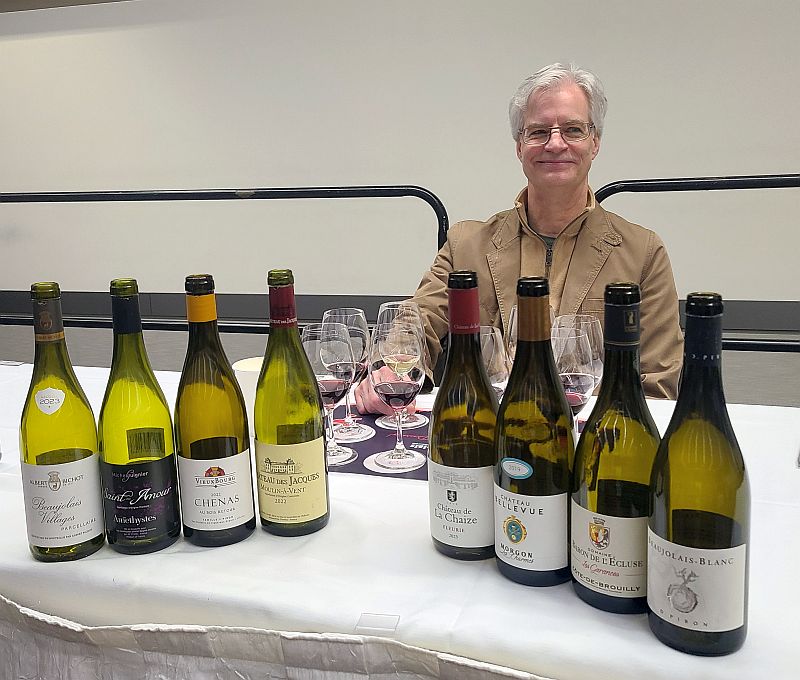
Educator, Iain Philip, teaching us about Beaujolais wines at VanWineFest 2026
Beaujolais is currently undergoing a radical strategic pivot, emerging as arguably the most dynamic wine region in France. For modern professionals, the historical fixation on “Beaujolais Nouveau” has long acted as a limiting monolith, obscuring the region’s profound terroir potential. Between the 1970s and the early 2000s, the region was defined by a one-dimensional image centered on immediate consumption and industrial speed. At its peak, Nouveau accounted for 55% of the region’s total production; today, that figure has collapsed to less than 20%. This decline represents a deliberate shift away from cash-flow-driven volume toward a diverse, terroir-centric model that honours the region’s two-millennium winemaking history. As we move away from the “fun but simple” cliché, we find a region defined by geological complexity and exceptional varietal adaptability.
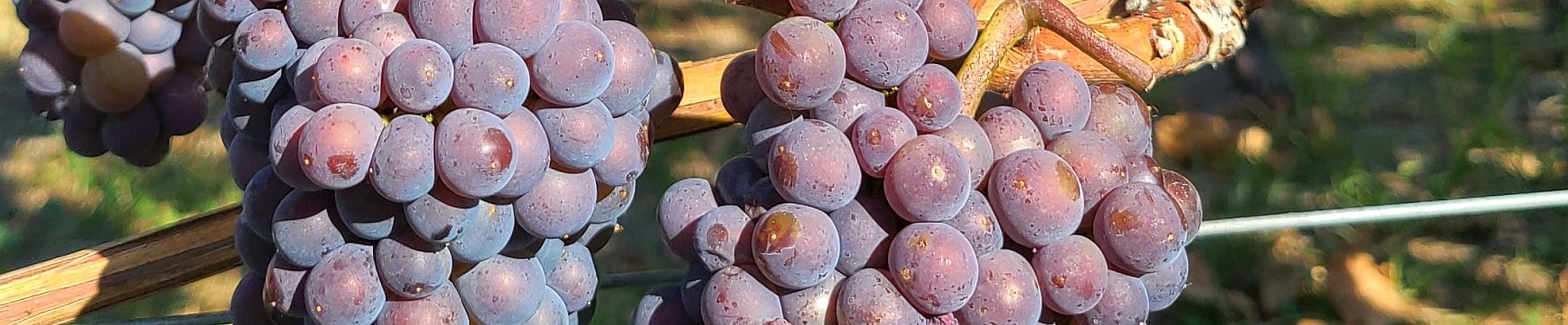
96% of Beaujolais wines are made from the Gamay Noir grape and 4% are made from Chardonnay. Of the 12 appellations that make up Beaujolais, the 10 Crus only produce red wines.
The Geography of Diversity
Beaujolais map showing the 10 Cru plus Beaujolais AOC and Beaujolais Villages (Image courtesy https://www.winescholarguild.org/blog/beaujolais-crus-what-makes-each-crus-special-with-map.html)
Iain started by telling us that understanding Beaujolais requires mastering its 55km north-to-south axis, situated between the Mâconnais to the north and Lyon to the south. This corridor is defined by the influence of the Massif Central to the west and the Saône River valley to the east, creating a varied relief that dictates distinct wine styles. The current focus on “parcellaire” (plot-by-plot) labelling is not a modern marketing invention but a return to historical prestige. An 1869 map of the region delineated over 200 individual plots, proving that Beaujolais once commanded prices and respect equivalent to the finest estates of the Côte d’Or in Burgundy.
The 13,000 hectares of vines can be organized as follows by topography and soils:
Topography
Soil Dominance
Specific Soil Types
Appellation Tier(s)
Southern Sector: Lower-lying plains and rolling hills
The professional standing of Beaujolais was fundamentally elevated by a watershed soil study conducted between 2009 and 2018. Through 15,000 surveys and pits dug every 12 hectares, researchers identified over 300 unique soil types, leading to the region’s status as a UNESCO Global Geopark. A critical differentiator for Beaujolais is the “Ice Age Factor”: while glaciers scraped away ancient topsoil in much of Northern Europe, but stopped just kilometres short of Beaujolais. This preserved a 500-million-year-old foundation that defines the following eras:
500 Million Years Ago: Formation of the bedrock, primarily Gneiss and Schist.
400 Million Years Ago: Intense volcanic activity while submerged, creating Blue Stone (Diorite).
300 Million Years Ago: The upheaval of the Granite Massif Central.
The Jurassic Era: Marine deposits forming the Limestone (Golden Stones / Pierres Dorées) of the south.
For the viticulturist, the contrast between Granite and Blue Stone is essential. Granite erodes into free-draining sand, producing delicate, red-fruited, and floral wines while Blue Stone erodes into fine clay-like particles that retain water and nutrients, resulting in “solar” resilience and wines with darker fruit, spice, and structural power. These soils provide the essential bedrock for navigating a changing climate.
Climate, the “Solar” Vintage Shift, and Environmental Initiatives
Iain noted that Beaujolais sits at a climatic crossroads, primarily continental but moderated by oceanic and Mediterranean influences. Climate change has shifted the region toward “solar” vintages (notably 2022 and 2023), characterized by high luminosity and heat. In this new reality, Gamayhas emerged as a resilient hero. Unlike Pinot Noir, which often struggles to maintain balance in extreme heat, Gamay retains its signature acidity and freshness even at 14% ABV. Despite the recurring threats of frost and hail, these solar conditions are producing wines of unprecedented concentration. Amidst this technical evolution, the culture of “Beaujonomie”, the philosophy of sharing, accessibility, and the joy of the table, remains the region’s human heartbeat.
As early as 1989, some winegrowers, together, studied their vines to determine the most sustainable way to protect them, respecting environmental, economic and social aspects, while preserving natural resources. This included maintaining or reintroducing biodiversity in the vineyards, limiting inputs to preserve soil life and water quality, and restoring the natural landscape. Many of the wineries are now certified in some way, such as Agriculture Biologique, Haute Valeur Environnementale (HVE), demeter (biodynamics), and more.
Vinification: Carbonic, Semi-Carbonic, and Burgundian Methods
The strategic choice of vinification defines whether a wine is “Expressive” (fruit-driven) or “Exceptional” (structured for age) according to Iain. The methods:
Full Carbonic Maceration: An anaerobic process in a sealed tank filled with CO2. It relies on an internal enzymatic reaction within the whole berry, producing soft, low-tannin wines with vibrant aromatics.
Semi-Carbonic Maceration: The regional standard. Whole clusters are placed in a tank; the weight of the fruit crushes the bottom layer, starting a yeast fermentation. This naturally produces the CO2 required for the top grapes to undergo carbonic maceration.
Burgundian Method: Traditional fermentation involving de-stemming and crushing, often with longer maceration (3–4 weeks) to extract the tannins and structure required for long-term cellaring.
It is vital to debunk the “banana and bubblegum” clichés surrounding Beaujolais wines. These aromas and flavours were never a natural by-product of the region; they were the result of industrial shortcuts, specifically from using Yeast 71B (an industrial tool used for speed rather than quality) and thermovinification. These techniques are largely absent in high-quality modern production.
Flight Review: Eight Expressions of Diversity
We had eight wines to try during this seminar taking us through most of the Crus of Beaujolais. This flight illustrates the spectrum of Beaujolais wines starting in the south and moving northward, with description by Iain followed by my wine tasting notes:
Maison Albert Bichot “Parcellaire,” Beaujolais Villages 2023: Reflecting the investment of Côte d’Or producers, this wine uses the Burgundian method. Fermentation is strictly kept below 25°C to preserve the delicate primary fruit of this high-elevation site. – This wine has a medium garnet colour. Light tart red fruit nose, plus a touch of candied cherries and oak. Dry, lean, medium body with crunch red berry flavours. Medium-plus acidity and light tannins.
Michel Guignier, Saint-Amour 2020: A practitioner of “natural” viticulture using horse-farming. Guignier uses a basket press and is fastidious about achieving a clean must, resulting in a layered, organic expression aged on the lees. – A medium garnet colour with some bricking. A light red cherry nose plus touches of leather and savoury notes. Dry, light body with a smooth but lean mouthfeel. Light intensity red fruit and tart red cherry flavours. Higher acidity and light tannins. Medium-plus length with a tart finish.
Domaine du Vieux Bourg, “Au Bois Retour,” Chénas 2022: Coming from the smallest Cru, this wine showcases the granite-driven purity and “juiciness” of the 2022 solar vintage. – This is the smallest of all the cru in Beaujolais and one of my favourite wines from this seminar. This wine has medium-minus intensity clear garnet colour in the glass. Dry, medium-plus body with a round, silky smooth mouthfeel. Floral (violets), red cherries and some candied cherries plus a touch of savoury herbs on the palate. Medium acidity and light tannins. Medium-plus length with a touch of oak on the finish.
Château des Jacques, Moulin-à-Vent 2022: A benchmark for the “Exceptional” category. Long maceration (3 – 4 weeks) creates a wine that begins to “Pinoter”, developing the structural elegance and aromatic profile of fine Pinot Noir. – Medium-plus intensity, dull garnet colour. Medium-minus intensity aromas of flint and deep red fruits. Dry, medium-plus body, with a round, thicker mouthfeel. Medium acidity and light tannins. Red cherries on the palate followed by tart red fruit and some oak. Lightly drying tannins and some puckering on the finish. –
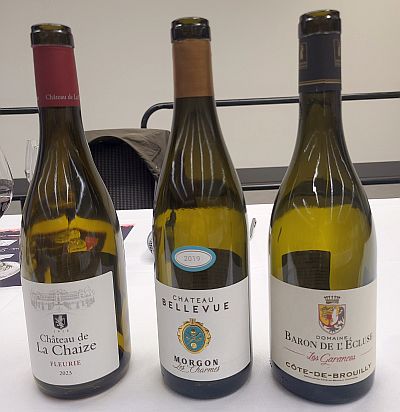
Château de La Chaize, Fleurie 2023, Château Bellevue Les Charmes, Morgon 2019, and Domaine Baron de l’Écluse, Les Garances, Côte de Brouilly 2022 winesChâteau de La Chaize, Fleurie 2023: From the region’s largest estate, this wine captures the “stony” minerality of granite, using concrete aging to protect its floral aromatics. – A medium-minus intensity garnet colour. Light candied red cherries on the nose. Dry, medium body with a super smooth mouthfeel. Medium-plus acidity and lighter tannins. Tart red fruits, cranberries?, dill?, and some minerality. A puckering finish.
Château Bellevue Les Charmes, Morgon 2019: An exploration of the verb “Morgana” – the specific aging process where Morgon evolves from primary fruit into savoury, earthy, and spicy depth. Morgon is the second largest cru. – This wine has a medium-minus intensity brickish-garnet colour. Light aromas of old oak, aged cherries and other savoury notes. Dry, medium body with a smooth, soft mouthfeel. Dill, aged red cherries and some nutmeg flavour toward the finish. Medium-plus acidity and light tannins.
Domaine Baron de l’Écluse, “Les Garances,” Côte de Brouilly 2022: Sourced from 90-year-old vines on volcanic Blue Stone. At 14% ABV, this “solar” wine resembles the Northern Rhône (Syrah) with its dark fruit, pepper, and spice more than it does Pinot Noir. – This wine has a deep garnet colour. Deep, rich ripe black fruit and sweet spices plus a touch of oak on the nose. Dry, medium-plus body with a soft, smooth, thicker mouthfeel. Deep black and red fruit flavours, along with touches of sweet spices and a mix of tart and candied cherries. Medium tannins get firmer on the finish. Tart finish.
Maison Piron, Beaujolais Blanc 2023: Our only white wine from Beaujolais. Sourced from the limestone border of the Mâconnais, this Chardonnay offers a “White Burgundy” profile at incredible value, highlighting the region’s versatility beyond Gamay. – A medium intensity, bright lemon colour. Soft aromas of lemon and lemon meringue pie on the nose. Dry, medium-plus body with a round, thicker mouthfeel. Medium-plus acidity. Citrus and crisp apple flavours. Medium length. –
To Conclude
Beaujolais currently offers a compelling value proposition in the fine wine market. While it once commanded prices on par with the legendary estates of the Côte d’Or, it now provides professionals and general wine lovers with access to world-class terroir wines at a fraction of the cost.
Thank you to the Vancouver International Wine Festival for providing me with a media seat to attend this seminar.
Drink Good Wine. That is my motto and I really want to help you drink good wine. What is good wine? That can be a different thing for each people. Food also loves wine so I also cover food and wine pairings, restaurant reviews, and world travel. Enjoy life with me.
MyWinePal was started by Karl Kliparchuk, WSET. I spent many years with the South World Wine Society as the President and then cellar master. I love to travel around the world, visiting wine regions and sharing my passion for food & wine with you. Come live vicariously through me, and enjoy all my recommended wines.
Try Gerard Bertrand Orange Gold Wine
Buy Masottina Brut Prosecco
Donate to the BC Hospitality Foundation
Drink Good Wine
We all want to drink good wine, but sometimes we need help picking a wine. Within this website you will find free information to help you purchase wines from around the world with confidence.
If you have any comments or suggestions on how to improve MyWinePal, please let us know. We value your feedback. Cheers.
Subscribe to MyWinePal's RSS feed:
Follow MyWinePal on Facebook:
Follow MyWinePal on Instagram:
Follow MyWinePal on threads:
Follow MyWinePal on bluesky:
MyWinePal Media Kit:
Video Guide Uncorks the Story of British Columbia Wines. Buy Now.
Buy CVNE Cune Crianza from Rioja
Enjoy Luigi Bosca De Sangre Cabernet Sauvignon
Click to Subscribe to MyWinePal
Subscribe to MyWinePal. Click on image.
Search in MyWinePal
MyWinePal Archive
World-Wide Wine News
(c) MyWinePal. Some articles may contain affiliate linkages.