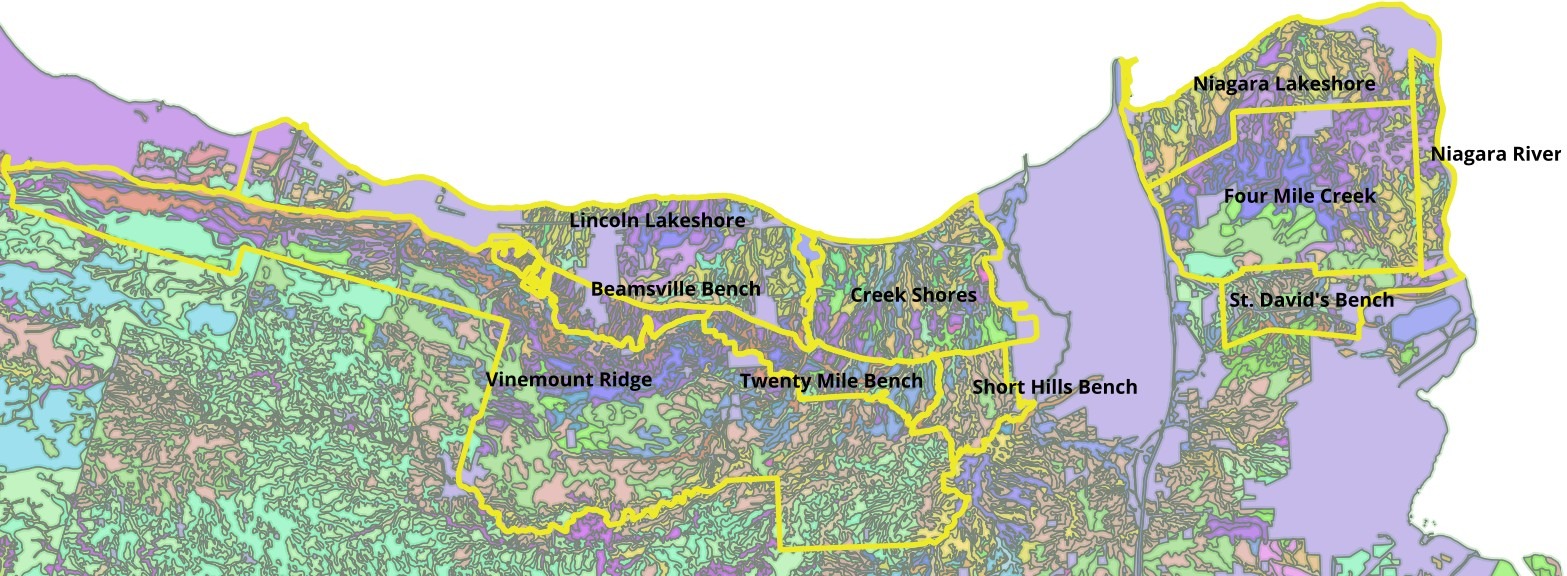
Soil is one of the important factors influencing the aromas and flavours produced by wine grapes. For my Ontario Chardonnay Review, I checked with the Government of Canada National Soil Database (NSDB) Soils of Ontario to determine the soil types associated with each of the Ontario wineries that provided their bottle(s) of Chardonnay. Using the free, open source, computer mapping software, QGIS, I overlaid the geographic locations of the wineries with Government of Ontario soil polygons. This provided me with a soil code. I then used the Soils of Ontario database to decipher the meaning of each code. I made the assumption that the vineyard used for the wines were near or adjacent to the winery.
Soil Types by Ontario Winery
| Winery | Name | Vintage | VQA Region | Soil |
| Dobbin Estate Winery | Chardonnay | 2020 | Twenty Mile Bench | ONEIDA – Brunisolic Gray Brown Luvisol |
| Drea’s Wine Co. | Blanc de Blancs | 2021 | Niagara Peninsula | CHINGUACOUSY – Gleyed Gray Brown Luvisol |
| Featherstone Winery | Unoaked Chardonnay | 2023 | Niagara Peninsula | ONEIDA –Brunisolic Gray Brown Luvisol |
| The Grange of Prince Edward | Chardonnay | 2024 | Prince Edward County | SOLMESVILLE CLAY – Gleyed Gray Brown Luvisol |
| Tawse Estate Winery | Chardonnay | 2023 | Vinemount Ridge | CHINGUACOUSY – Gleyed Gray Brown Luvisol |
| Cave Spring Vineyard | Estate Chardonnay | 2024 | Beamsville Bench | CASHEL – Orthic Melanic Brunisol |
| Henry of Pelham Family Estate Winery | Chardonnay Special Family Reserve | 2024 | Short Hills Bench | BRANTFORD – Brunisolic Gray Brown Luvisol |
| Speck Bros. Wine | The Goat Lady Chardonnay | 2023 | Short Hills Bench | BRANTFORD – Brunisolic Gray Brown Luvisol |
| Wending Home Estate Vineyards & Winery | Estate Vineyard Chardonnay | 2023 | Creek Shores | CHINGUACOUSY – Gleyed Gray Brown Luvisol |
This table shows one record for each winery, although some wineries sent me more than one bottle of their Chardonnay. Most of the wines are from either Brunisolic Gray Brown Luvisol or Gleyed Gray Brown Luvisol, with one wine coming from the Orthic Melanic Brunisol type. For those of you who are not soil scientists, the following information from the Soils of Ontario database has this description for each of the soil types:
Brunisolic Gray Brown Luvisol
Sediment, generally consisting of either stratified fine sand, silt, and clay deposited on the lakebed, or moderately-well sorted, stratified sand and coarse materials that consist of near lake shore or beach deposits. These materials have either settled from suspension in bodies of standing fresh water or accumulated at their margins through wave action. Moderately / Very Strongly Calcareous.
Gleyed Gray Brown Luvisol
Morainal material (till) deposited by glacial ice: a mixture of boulders, sand, silt, and clay. Moderately / Very Strongly Calcareous.
Orthic Melanic Brunisol
TOPMOST: Sediment, generally consisting of either stratified fine sand, silt, and clay deposited on the lake bed, or moderately-well sorted, stratified sand and coarse materials that consist of near-lakeshore or beach deposits. These materials have either settled from suspension in bodies of standing fresh water or accumulated at their margins through wave action. Moderately / Very Strongly Calcareous.
BELOW: Morainal material (till) deposited by glacial ice: a mixture of boulders, sand, silt, and clay. Moderately / Very Strongly Calcareous.
Meaning of Soil Types, Similarities, and Differences
These three soil types are all calcareous soils, meaning they contain moderate to very high levels of calcium carbonate. This calcareous nature can help maintain soil structure and influence vine nutrition, while often contributing to wines with good freshness and minerality.
The Brunisolic Gray Brown Luvisol and Orthic Melanic Brunisol share a similarity in their upper soil layers. Both contain sediments that were deposited in ancient lake environments, consisting of varying amounts of sand, silt, and clay. These lake-derived materials tend to be well layered and can provide a balance between water retention and drainage, depending on the proportion of fine and coarse particles present.
The Gleyed Gray Brown Luvisol differs because it is formed directly from glacial till. Rather than being sorted by water, glacial till is an unsorted mixture of boulders, sand, silt, and clay left behind by retreating glaciers. This creates a more variable soil structure, with pockets of different particle sizes occurring throughout the profile.
The Orthic Melanic Brunisol can be viewed as a combination of the other two soil environments. Its upper layer consists of lake-deposited sediments, while beneath lies glacial till. This layered structure may offer some of the benefits of both parent materials. The upper sedimentary layer can encourage root development and moderate water availability, while the deeper glacial till provides additional mineral diversity and rooting depth.
Another important distinction is found in drainage characteristics. The term “gleyed” in Gleyed Gray Brown Luvisol indicates that the soil experiences periods of poor drainage or seasonal saturation. This often results in grayish colouring within the soil profile due to reduced oxygen levels. In contrast, Brunisolic Gray Brown Luvisol and Orthic Melanic Brunisol generally have better drainage and aeration, allowing roots to penetrate more freely.
The Next Steps
Now that I know the soil types associated with each wine, I will next determine which aromas and flavours were most common from my wine tasting notes, classified by the three soil types. Also, I will check into the variability of the growing season for these wines to help determine the resulting aromas and flavours. I have wines from 2020 to 2025, although most are from 2023 and 2024. For example, a cool vintage would tend to produce higher acidity and more citrus and green apple aromas and flavours for Chardonnay, while a hot vintage would produce riper stone and tropical fruit aromas and flavours. Stay tuned for these upcoming articles.