This is my ninth year interviewing winemakers or winery principals in Ontario about their latest grape harvest and wine production. Now that it is late November and the wines are all in tanks or barrels, how did the Ontario grape growing season and harvest fare? BC had some forest fire smoke while Ontario had some flooding. I interviewed three winemakers/winery principals this year:
- Ryan Oldridge, Winemaker at Colchester Ridge Estate Winery in Colchester
- Amy Baldwin, Winemaker at Waupoos Estates Winery in Picton
- Chris Robinson from Kacaba Vineyards and Winery in Vineland
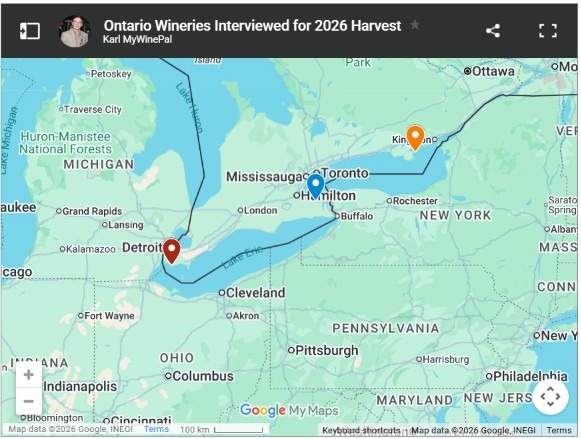
Where Are These Wineries?
Here is a Google map showing the location of the wineries, colour-coded to the winemaker names above.
My Interview with the Ontario Winemakers
Thank you to these winemakers for taking the time to answer my interview questions and let my readers find out more about their wineries and the progress of their 2024 grape harvest.
1. Where are your vineyards and winery located?
Ryan: Colchester Ridge Estate Winery, also referred to as CREW, is located in the little hamlet of Colchester in Southwestern Ontario along the north shore of Lake Erie.
Amy: Waupoos Estates Winery is located at 3016 County Road 8, Picton ON, K0K 2T0 (Prince Edward County).
Chris: Kacaba Vineyards and Winery is in the Niagara Escarpment/Twenty Mile Bench sub-appellation in Vineland, Ontario.
2. How would you summarize your 2026 harvest in terms of timing, yield and fruit quality compared to 2025 and your longer-term average?
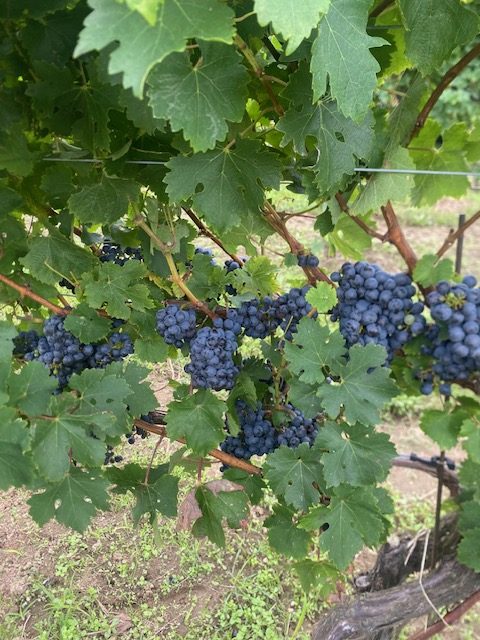
Ryan: Yields were definitely down this year in the Lake Erie North Shore. A significant winter event caused some heavy damage throughout the vineyard, mainly in our most sensitive varieties like Merlot. Despite the challenges, we’re focused on making the most of the fruit we were able to harvest.
Amy: 2026 was a challenge for us in our location for sure. We had one day of -27 and that really started our growing season at a disadvantage. It was a colder, rainy spring which led to other challenges in the vineyards. We were down significantly compared to other years.
Chris: Compared to the accelerated 2025 vintage, where we had intense heat that forced an exceptional harvest with much higher sugar levels, we had to keep an eye on the balance within the grapes, particularly to the acidity to retain freshness. In 2026, Kacaba Vineyards has started almost 3 weeks later than previous years, and I tip my hat to the masterclass of our vineyard management team, Vailmont. We’ve had to keep our patience and be adaptive in our vineyard practices early on in the season. We’ve made critical decisions and strategized to maintain a balanced crop load and manage ripening while anticipating early on the warmth we would be getting in October. The yields are comparable in some respects as last years. Some Syrah, Merlot and Cabs are 20% lower than in 2025, but all in all we’ve got an average tonnage.
3. With the mid-summer heavy rain and flooding, followed by September sunshine, did the flooding have any adverse effects on the vineyards? Did you have to change your canopy management? Did it affect cluster size, berry size, or flavour development?
Ryan: We didn’t see the heavy rains or flooding the Niagara region saw, but we also didn’t get away without our own issues. Persistent rains prevented vineyard work from being done in a timely manner. As the June and July heat came around, this caused considerable humidity, which in turn handed us disease pressure. It required close attention in the vineyard and vigilance throughout the growing season.
Amy: Luckily, we didn’t have any serious flooding in our area, but we did have a lot of powdery and downy mildew to combat in our vineyards. The grapes we brought in have great flavour and lots of potential to become amazing wines.
Chris: We had record amounts of rainfall this year, no doubt. Fortunately, because we strategically maintained two clusters per shoot and avoided dropping fruit, the crop load effectively regulated the vine’s water intake, perfectly utilizing the soil’s moisture reservoir to shield our fruit from splitting or desiccation. Building on two years of trials with mechanical leaf removal, we stripped both sides of the canopy early this season without knowing the extreme weather ahead. This strategy maximized our airflow that’s critical to successfully mitigating any disease pressure. Propelled by the record moisture, cluster weights were up across the vineyard and in some cases weighing nearly 100 grams more than average.
The flavour itself is there; it is now simply a matter of being patient to achieve full phenolic ripeness and wait for that perfect balance to pick, though the true long-term impact of these intense weather swings on vine health won’t fully reveal itself until next spring.
4. Were there any varietals or blocks that surprised you by standing up to the wetter weather, either positively (better than expected) or negatively (lagging, disease, or flavour issues)? How did you respond in your harvest strategy?
Ryan: I think our main issue down this way was the winter damage and how it affected overall fruitfulness. Speaking specifically about CREW, we saw a negligible amount of fruit in the Merlot and our Chardonnay block. Our young Cabernet Franc plants historically would produce around 4 tonnes and gave us 2.1 even with tying down more buds, trying to maximize the buds while being sure not to work the plants too hard. While yields were lower than expected, we’re looking forward to seeing how this vintage comes through in the bottle.
Amy: In all honesty, it was a challenging year for grapes, given the yield was down on all varieties. That said, harvest strategy evolves every year – you always have a master plan… but it also always gets derailed by the weather. We work with what we have, and on the clear days nature allows us to do it, so it doesn’t always go according to ‘plan.’ You must be flexible in this industry!
Chris: Our Estate Syrah blocks provided the biggest surprise. Syrah can be incredibly challenging to grow on the Bench even in a good year, but we were saved by a strategic operational choice set in motion back in 2025. We have the oldest planting of Syrah in Eastern Canada, and this block of Syrah is a clone that produces beautifully loose berries but carries incredibly thin, vulnerable skins. Knowing those thin skins would have caused us severe breakdown and rot issues under the intense moisture that 2026 brought, we pivoted our harvest strategy completely and executed our secret plan to pick the entire block early for a premium sparkling wine program (ssshh!). Thus, perfectly demonstrating how adaptive, forward-thinking harvest strategies can turn a potentially challenging block into a major success.
5. Given the fruit you harvested this year, did you make any changes in the winery (fermentation vessels, maceration time or maturation regime) to reflect the crop and the style you wish to express?
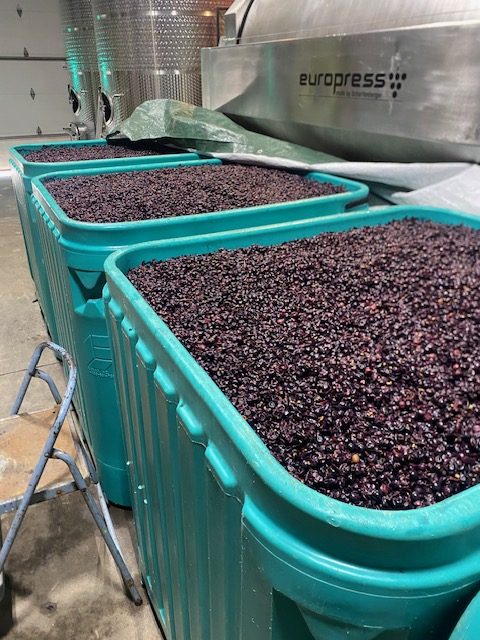
Ryan: Given the smaller amount of fruit processed this year, nothing out of the ordinary was utilized. Bin ferments instead of large stainless vessels for our reds meant I was able to employ timely punch downs on the Cabernet Franc and Cabernet Sauvignon as opposed to our usual pump overs. But mitigating fermentation temperatures in an insulated grape picking bin is a task in itself.
Amy: No major changes on the production side, the fruit we did bring in was clean with good brix. I did switch up some of the yeast strains that I typically use year to year.
Chris: To handle the 2026 fruit, I immediately adapted our cellar protocols by introducing sacrificial tannins or protecting the grapes’ structural integrity against the heavy rains. While our cold-soaking protocol remained unchanged, we experimented with new yeast strains during fermentation to maximize flavour expression in a variable vintage. For aging, we used 25% new French and American oak but shifted our strategy to toward 500L puncheons. These larger-format barrels give us the precise structural impact we want, allowing us to control the extraction and use less new oak with specific wines.
6. Are you experimenting with anything new with this harvest, like making a sparkling wine, using amphora or skin-fermented white wines?
Ryan: Unfortunately, nothing new is being planned for this year’s harvest. Instead, much of our focus has been on investing in the future of the vineyard. We removed about an acre worth of our Merlot, and it will be replanted as Pinot Gris in the spring. This is an opportunity to continue improving our portfolio while selecting varieties to withstand potential winter stressors in the future.
Amy: With the unpredictable weather this year, we didn’t really have the crop load to try new things. Some years that’s the case, but we are hopeful to do more in 2027.
Chris: Yes, other than what I’ve mentioned above (sshh!), I’m bringing in new varieties Kacaba Vineyards have never worked with: Petit Verdot and Malbec. I’ve also got Ukrainian Oak from Tonnellerie Vicard and aging Viognier, Syrah and Cabernet Sauvignon in them. Kacaba is the first winery in Canada to be using Ukrainian oak sourced and made by the prestigious cooperage from France. I have a few other things up my sleeve for this year, so you’ll just have to wait and see! <MyWinePal: Exciting!>
7. What are you going to do to celebrate the completion of the Harvest?
Ryan: With a cold beer. I had a professor tell me years ago that “it takes a lot of beer to make great wine”… well, with these small quantities this year, so I guess I’ll test his advice.
Amy: It’s always a nice sigh of relief when harvest is complete. I’m looking forward to enjoying the fall weather (when it gets here, it’s another 20-degree day here!). No grand plans per say.
Chris: I look forward to celebrating with close winemaker friends and family. Always after being absent from people’s lives during harvest, it’s important to see everyone again and get back into daily routine.
8. Is there anything else you’d like Canadian wine lovers to know about your wines or winery?
Ryan: Whether it be 200L or 2000L, the same hard work and attention to detail is put into every fermentation, every bottle. These wines will tell a story. 2026 will be the small, but mighty vintage for wines produced under the VQA Lake Erie North Shore designation.
Amy: Waupoos Winery is very dog friendly!! We have added a fully enclosed dog park here at the winery, so you can enjoy a flight while your four-legged bestie runs around! There is a small retail section in our boutique “The Good Dog Shop,” which is a little collection of toys and treats for very good pups. We have also created a wine with a cause in collaboration with Can Pet Cares. Five dollars from every bottle of Pet Tails wine that is sold goes directly to Can Pet Cares who distributes the funds to local humane societies, helping with animal rescue, shelter and welfare. To date we have raised $10,000!
Chris: In addition to our foundational story and pioneering roots on the Niagara Benchlands, there are a few exciting developments our Canadian wine lovers will not want to miss. We’ve launched two new labels:
1. Small-Lot making limited small lot cases of Viognier (SOLD OUT), Cabernet Sauvignon (40 cases), and Syrah (50 cases).
2. MONOLITH (Syrah, and a Cabernet Franc)
Events like our upcoming Holiday Open House and Barrel Tasting gives guests a chance to step right into the cellar, talk directly with me and the winemaking crew, and sample the highly anticipated upcoming vintages directly from barrel. Whether you have been collecting our reds for years or are discovering us for the first time, our goal is to consistently deliver small-batch, sustainably grown wines that reflect the strength and character of our vineyard.
Visit Kacaba.com for up to date events or follow on social media. Cheers!
Summary of the Season Based on Winemaker Responses
2026 Harvest Overview
Ontario’s 2026 wine harvest was shaped by a difficult winter, a cool and wet spring, record rainfall in some areas and a delayed growing season. At Colchester Ridge Estate Winery on the Lake Erie North Shore, winter damage significantly reduced yields, particularly in Merlot, while Waupoos Estates in Prince Edward County was hit by -27°C temperatures followed by a cold, rainy spring. Kacaba Vineyards on the Twenty Mile Bench also started harvest almost three weeks later than usual, although its overall tonnage remained close to average, with some Syrah, Merlot and Cabernet blocks down about 20% from 2025.
Rain was another common challenge, although its impact varied by region. Colchester Ridge experienced persistent rain, followed by summer heat and humidity that increased disease pressure. Waupoos avoided serious flooding but had to manage powdery and downy mildew. Kacaba experienced record rainfall, but careful crop and canopy management helped protect the fruit. The challenge was then to wait for the fruit to achieve full phenolic ripeness while maintaining freshness.
The vintage also demonstrated the importance of adapting harvest decisions to individual vineyard conditions. At Colchester Ridge, winter injury was the major concern, while Waupoos described a season in which the harvest plan continually changed with the weather. Kacaba took a more proactive approach with its vulnerable Syrah block, harvesting it early for a premium sparkling wine program rather than risk rot from the intense moisture.
Despite the challenges, the three winemakers remain optimistic about the quality of the fruit that was harvested. Waupoos reported clean fruit with good Brix and flavour, while Colchester Ridge is looking forward to seeing how its smaller crop develops in bottle. Kacaba is taking a patient approach as the fruit reaches phenolic maturity. The result is a vintage that will likely be remembered for lower yields in several regions, significant weather variation and, above all, the ability of Ontario’s grape growers and winemakers to adapt. As Colchester Ridge’s Ryan put it, 2026 could be a “small, but mighty” vintage for Lake Erie North Shore wines.
Thank you to all these winemakers for taking the time to tell me, and you, about their grape growing and winemaking season.