- Which wine do you buy?
- How much more are you willing to pay for the 90 point wine over the 89 point wine?
- Would you feel upset if you could not afford to buy the 90 point wine?
- Do you think you could tell a difference in wine quality, flavours, and aromas between the two wines?
- Did the same group rate both wines or different groups/people? Do you know either group/person?
Origins of the 100-Point Scale
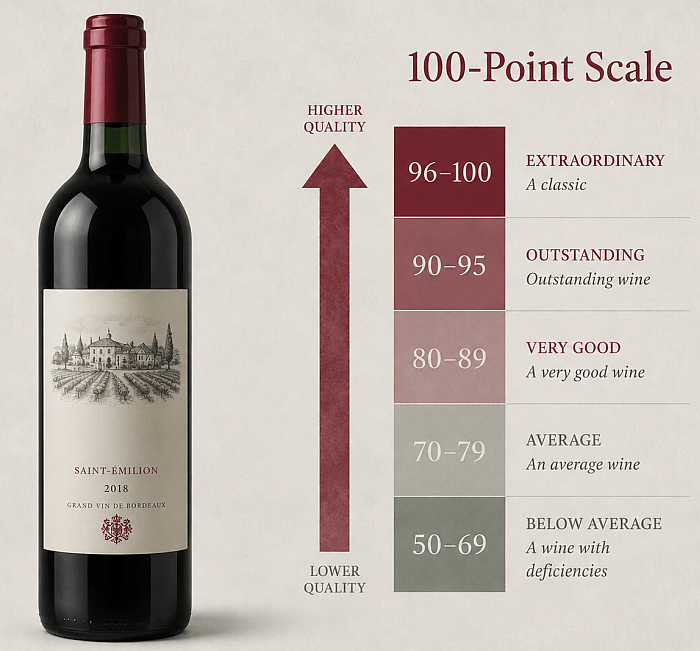
Breakdown of the 100-Point Scale
| Score Range | Meaning |
| 96–100 | Extraordinary wine with profound character and complexity |
| 90–95 | Outstanding wine with exceptional traits |
| 80–89 | Above average to very good; shows finesse and flavour |
| 70–79 | Average; soundly made but lacking distinction |
| 60–69 | Below average; noticeable flaws like excessive acidity or off aromas |
| 50–59 | Unacceptable; seriously flawed |
- A plus sign (+) indicates potential for improvement over time.
- A range in parentheses (e.g., 90–93) suggests a barrel tasting with estimated potential.
- A question mark (?) may be used when a wine’s quality is uncertain.
How A Wine is Graded
| Category | Points Available | Description |
| Colour & Appearance | Up to 5 | Evaluates clarity, depth, and hue of the wine |
| Aroma & Bouquet | Up to 15 | Assesses the complexity, intensity, and appeal of the wine’s nose |
| Flavour & Finish | Up to 20 | Judges taste, balance, mouthfeel, and how long the flavours linger |
| Overall Quality | Up to 10 | Reflects the wine’s aging potential, harmony, and overall impression |
- 5 for appearance
- 13 for aroma
- 18 for flavour
- 6 for overall quality
- plus the base 50 points
Controversies, Influence, and Gaming the System
- Instantly boost a wine’s price and prestige
- Open doors to international distribution
- Create cult status among collectors
Common Tactics Used to Game the Parker Rating System
From what I’ve read, these are the tactics that have been used to game the Parker Rating System.
One of the most common ways wineries tried to influence scores was through style manipulation, often referred to as “Parkerization.” Producers crafted wines to align with the preferences of influential critic Robert Parker, favouring deeply coloured reds with ripe fruit, elevated alcohol, concentrated flavours, and generous oak aging. The ripple effect was felt across regions such as Bordeaux, Napa Valley, and the Rhône Valley, where many wines began to taste more alike than different. Critics of this trend argued that regional character, elegance, and terroir expression were often sacrificed in pursuit of higher scores.
Another tactic involved optimizing barrel samples before critics tasted them. Since many reviews were conducted while wines were still aging in barrel, wineries occasionally presented samples that were not fully representative of the final bottled blend. A polished and concentrated barrel sample could attract an impressive preliminary score, generating excitement among importers, collectors, and consumers long before the wine reached the market.
Score shopping also became a common marketing strategy. Rather than relying on a single critic’s opinion, wineries submitted their wines to multiple reviewers and publications. When the scores came back, only the most flattering number was highlighted in advertisements, shelf talkers, and bottle tags. If one publication awarded a wine 88 points while another offered 94, consumers could safely assume which score would dominate the promotional material.
Reviewer targeting added another layer to the relationship between wineries and critics. Some producers invited select reviewers to exclusive tastings, private dinners, or luxury winery visits in hopes of building goodwill and increasing the likelihood of positive coverage. While these interactions rarely crossed into outright bribery, they occupied an ethical gray zone where hospitality and access could subtly influence perception and judgement.
Scarcity and hype were also powerful tools in the scoring game. Limited production wines, especially those carrying very high ratings, were often marketed as rare treasures destined to disappear quickly from the marketplace. A wine described as “only 300 cases produced” alongside a glowing 98-point review could ignite a buying frenzy almost overnight. The perception of rarity, combined with elite scores, frequently drove prices upward and created waiting lists among collectors eager to secure an allocation.