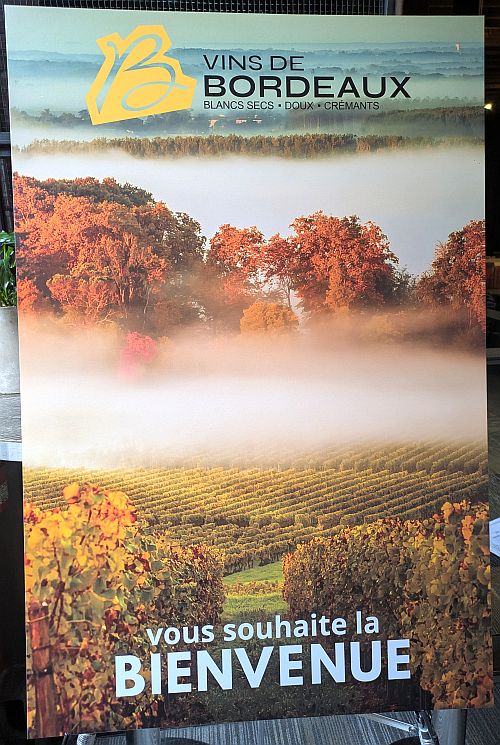
Vins de Bordeaux welcome sign
How often do you drink white Bordeaux wines? Do you know that they range from bone dry to lusciously sweet? Do you know which grape varieties go into white Bordeaux wines? I recently attended a seminar at L’Abbatoir in Gastown, covering these wines and some ideas for wine pairings that was hosted by Wines of Bordeaux. Our speaker was Emma Baudry who has been working with the Wines of Bordeaux for over 20 years. She noted that all ten of the white Bordeaux wines that we tasted during the seminar are from wineries that do not yet have representation in BC. So, if you are a wine agent in BC and are interested in adding white Bordeaux wines to your portfolio, these were all very good quality wines. It should be noted that the Canadian market, remains a primary destination for exports.
Emma started off the seminar providing us with the geographical region for white Bordeaux wines, methods of production, information about each winery and wine, then the pairings of wines with dishes.
Introduction to the Contemporary Landscape of White Bordeaux
Our speaker, Emma BaudryIn the grand hierarchy of global viticulture, Bordeaux is often reduced to its legendary red blends, yet the true technical vanguard of the region lies in its white production. While red wine dominates 85% of the vineyard area, white Bordeaux represents 11%, a figure that belies its strategic importance. This rarity creates a distinct value proposition: these are not merely alternatives to reds, but wines of top quality
The region is shaped by the confluence of three rivers. Production is divided between the “Left Bank” and “Right Bank,” with specific small appellations clustered along the riverbanks. The soil composition, a mix of limestone, clay, and gravel, plays a definitive role in the complexity and aging potential of the wine.
The white wine landscape is defined by a triad of styles: the high-acid, mineral dry whites; the luscious, concentrated sweet wines (of varying degree); and the “Cotes”, smaller appellations that offer high-quality innovation outside the traditional spotlight. Emma noted that only 2% of the total production is dedicated to the specialized sweet wines of the south.
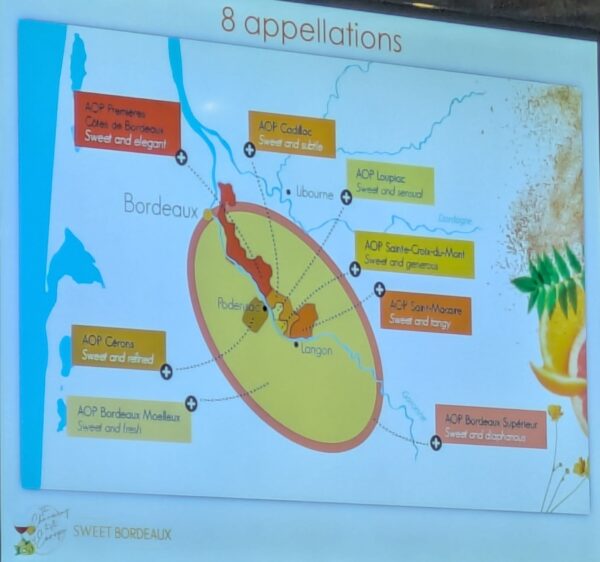
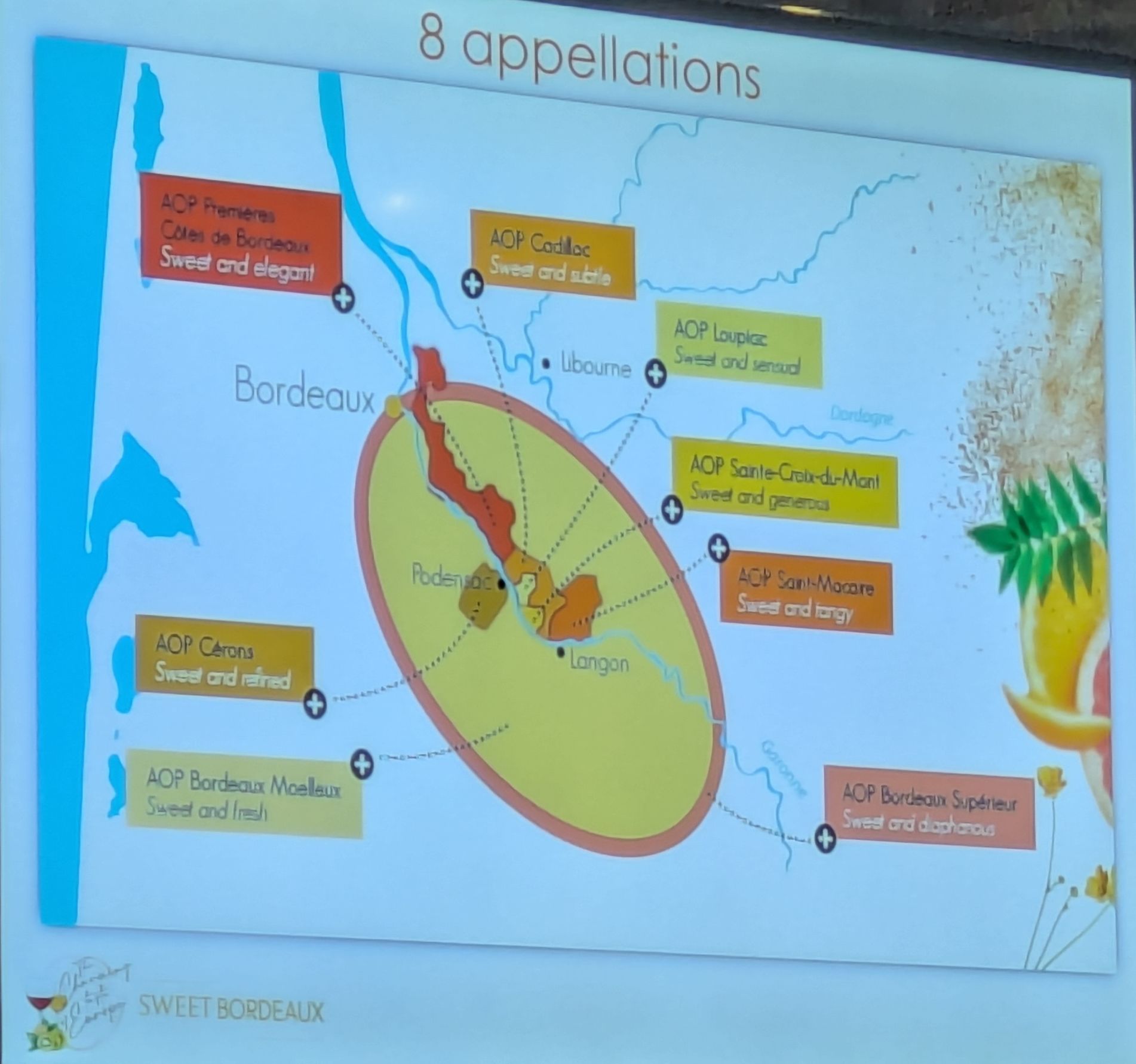
There are eight appellations that produce sweet white Bordeaux wines:
Eight appellations for sweet white Bordeaux winesAOP Bordeaux Superieur
AOP Cadillac
AOP Cérons
AOP Saint Macaire
AOP Bordeaux Moelleux
AOP Loupiac
AOP Premières Côtes de Bordeaux
AOP Sainte Croix du Mont
Historical Evolution from Sweet Whites to Dry Reds
To understand the modern Bordeaux palate, one must recognize that the 1950s was an era where sweet wine was the undisputed king. However, as red wine ascended, white production declined. The rebirth of sweet white Bordeaux wines began in the laboratory and the classroom during the 1990s. The late Denis Dubourdieu, owner of Clos Floridène and a figure often described as the “famous protester” who fought against the marginalization of white Bordeaux, led this charge.
He traveled to the Loire Valley to study why their Sauvignon Blanc possessed a vibrancy that Bordeaux lacked. His discovery of specific aromatic molecules, and how to preserve them through specialized skin contact and temperature control, changed everything. By identifying the specific terroirs, often influenced by the proximity to the Garonne and Dordogne, Dubourdieu elevated the white label from a secondary product to a superior wine, setting the stage for a new era of terroir-driven winemaking.
Sauvignon Blanc and Semillon are the primary grapes used for these white wines, sometimes with the addition of Muscadelle and/or Sauvignon Gris.
The Art and Science of Production: Harvesting and Fermentation
The distinction between premium white Bordeaux and mass-market alternatives is a matter of law. For the region’s prestigious labels, hand harvesting in small baskets is not a choice; it is a regulatory mandate. If a producer utilizes machine harvesting, they are legally prohibited from using the specific appellation designation on their label. This ensures that only intact, non-oxidized fruit enters the cellar.
In the winery, the fermentation and aging methods vary:
Vessel Type: While oak provides vanilla and structure, many modern specialists utilize concrete tanks. These tanks imaintain a dryness and a brightness that reflects the pure limestone terroir.
Aging Duration: Premium botrytized wines typically require 18 months of aging (often in new oak) to integrate their complex sugars, while lighter styles may rest for 9 months to preserve their primary fruit. Emma also noted that barrel aging brings out the peach aromas faster than aging in stainless steel tanks.
Assemblage: Complexity is achieved through the art of the blend. Different vineyard parcels are fermented separately and blended only after the fermentation is complete to ensure a balanced, multi-dimensional final profile.
Botrytis Cinerea: The Mechanics of Concentrated Sweetness
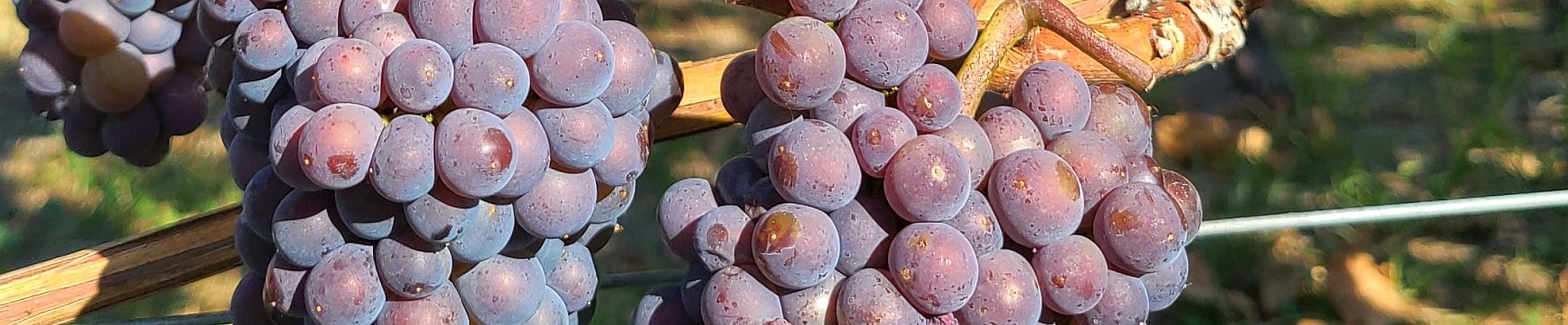
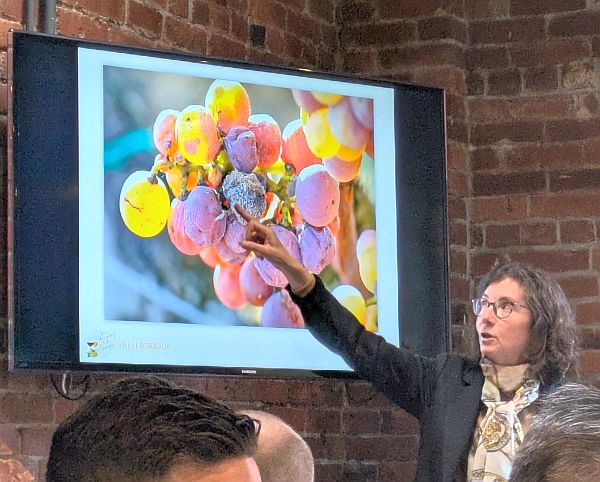
Emma pointing out the degrees of noble rot in grapesWorld-class sweet Bordeaux is the result of a strategic biological partnership with Botrytis cinerea, or “Noble Rot.” This micro-fungus is a volatile ally; it requires the morning mists of the rivers and the dry afternoons of the autumn sun. The fungus thins the grape skin, turning the fruit a distinct violet color and dehydrating the berry. This is not merely about “sugar”; it is about an organoleptic transformation that develops notes of exotic spices, apricots, and honey.
The harvest is a grueling process known as the “Tries” method. To achieve the required 90g+ of residual sugar, harvesters must pass through the vineyard up to five separate times, selecting only the individual berries that have reached the perfect state of noble rot. This stands in stark contrast to simple sweet wines, where fermentation is simply stopped by cooling to retain a sugar level of approximately 38–45g. These high-concentration Botrytis wines are built for a lifespan of 30 years or more, evolving from primary fruit into deep, spicy complexity.
Emma’s Wine Comments and My Wine Tasting Notes
For each of the wines below, the first paragraph will be Emma’s comments about the wines, followed by my tasting notes paragraph.
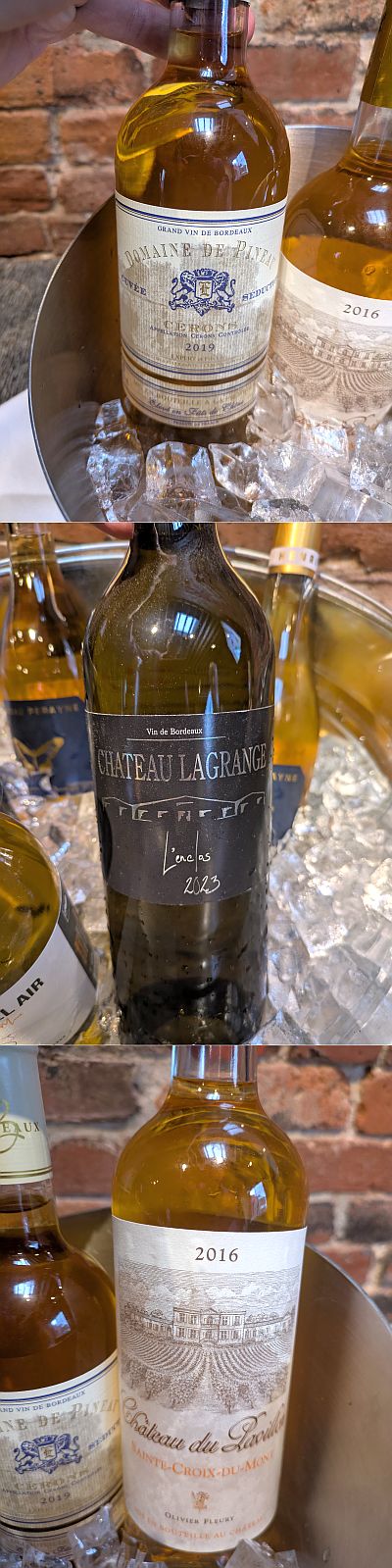
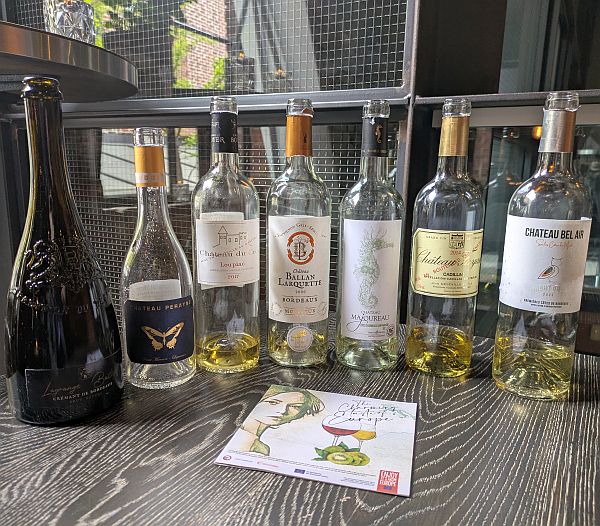
Sweet white Bordeaux wine flight of bottles
1. Château Lagrange, Crémant de Bordeaux – This cuvée serves as a sophisticated, high-value alternative to Champagne, distinguished by its meticulous hand-harvesting and traditional method production. Crafted in an “Extra Brut” style with a dosage under 5g/L of residual sugar, it utilizes a crisp effervescence to refresh the palate and sharpen the organoleptic focus before a meal.
Made with 100% Semillon grapes, fermented in concrete. Medium lemon colour. Light stone fruit nose. Dry, medium body with a lean mouthfeel. Tart citrus and apple flavours. Small, biting bubbles. A touch of bitterness. –
2. Château Majoureau 2024, Côtes de Bordeaux Saint Macaire – The complexity of this wine is anchored by the estate’s 17-year-old vines, which yield fruit with enhanced structural depth and concentration. Its location down-river imparts a specific microclimatic influence that balances the ripeness of the berries with a persistent, mineral-driven finish.
80% Sauvignon Blanc and 20% Semillon. Pale lemon color. Medium itensity aromas of pine needles that continued to the palate. Dry, medium-minus body with a lean mouthfeel. Medium length. –
The remaining sweet white Bordeaux bottles3. Château Ballan Larquette 2020, Bordeaux – This estate features a unique soil profile of clay and gravel at the summit, where owner Chantal employs a “no-oak” regimen in underground concrete tanks to preserve the varietal purity of the blend. Historically significant, the estate is linked to Mr. Lamadak (Cadillac), the founder of Detroit, whose legacy is celebrated through this traditional, concrete-aged expression.
60% Savuginon and 40% Semillon. A light lemon colour. Light honey and apricot aromas. Light body, semi-sweet. Soft and smooth mouthfeel. Medium-minus acidity. Apricots and honey on the palate. Very tasty.
4. Château du Cros 2022, Loupiac – This wine represents an intensive viticultural effort, requiring five separate harvest passes to select only the most perfectly botrytized berries. Following selection, 18 months of maturation in new oak imparts a sophisticated spice and vanilla structure that complements its concentrated sweetness.
90% Semillon, 5% Sauvignon Blanc, and 5% Muscadelle. A deep golden colour. Medium intensity, deep, rich aromas of dried stone fruits and honey. Medium-plus sweetness. Smooth, soft, thicker mouthfeel. Sweet spices and dried stone fruits, plus some nuttiness on the palate.
5. Château Lagrange – l’Enclos 2024, Bordeaux – Sharing the same lineage as the Crémant, this dry white expression demonstrates significant structural evolution and an aging potential of approximately five years. The winemaking emphasizes a precise, still-wine profile that contrasts with its sparkling sibling, offering a broader textural experience on the mid-palate.
60% Sauvignon Blanc and 40% Semillon. A light lemon colour. Light citrus, grapefruit, and salty minerality on the nose. Dry, light body with a smooth, lean mouthfeel. Apricot with touches of butterscotch, oak and nuttiness on the palate. A wine with a light touch.
6. Château Bel Air – Night Owl 2023, Premières Côtes de Bordeaux – Designed to appeal to a modern palate, this “gateway” sweet wine arrests fermentation through rapid cooling to maintain a vibrant residual sugar level of 38-45g/L. The result is a fresh, exotic fruit profile that prioritizes accessibility and primary aromatics over heavy oak influence.
100% Semillon. Light lemon colour. Medium intensity aromas of citrus, green fruit, and salty minerality. Light body, semi-sweet, with a soft mouthfeel. Medium acidity. Light arpricot and honey flavours. Medium-plus length.
7. Château Perayne 2022, Côtes de Bordeaux Saint Macaire – This wine is defined by dominant citrus aromatics, specifically a pithy, zesty grapefruit profile that avoids the sweeter, floral characteristics of pink grapefruit. The high-acid backbone and thiol-driven aromatics provide a focused, “bitter-tonic” finish that makes it an ideal pairing for brined or acidic starters.
100% Semillon. A deeper apricot colour in the glass. This wine has a touch of botrytis, but mostly is made from overripe grapes. It hasa light intensity, dried apricot nose. Medium sweetness. A thicker, smooth mouthfeel. Medium acidity. Rich honey and apricot flavours. Medium plus length. –
8. Château Fayau 2014, Cadillac – Hailing from the Cadillac appellation, this 2014 vintage showcases the remarkable evolution of botrytized fruit over a decade of aging. The secondary characteristics have begun to emerge, offering a glimpse into the longevity and aromatic transformation inherent to the region’s traditional sweet wines.
90% Semillon, 5% Sauvignon Blanc, and 5% Muscadelle. Medium intensity aromas of floral and apricots. Medium-plus body with a smooth, thicker mouthfeel. Medium acidity and sweetness. Ripe apricots and dried apricots on the palate. Medium-plus to a long length. –
9. Domaine de Pineau cuvée séduction 2016, Cérons – This cuvée highlights the elegance of the Cérons appellation, a small enclave known for its specific limestone terroir. The “séduction” profile focuses on a harmonious balance, where the limestone-driven acidity cuts through the sugar to provide a clean, lifted finish.
100% Semillon. A deeper apricot colour. Light apricot aroma along with ginger. Light body, dry with ginger and apricots on the palate. Medium acidity.
10. Château du Pavillon 2016, Sainte Croix du Mont – Situated on “old blue limestone” rich with oyster fossils, this estate, founded in 1826, produces a traditional powerhouse with a high concentration of approximately 90g/L residual sugar. The mineral intensity of the fossilized soil provides a critical counter-ballast to the high sugar levels, resulting in a wine of immense complexity and historical gravitas.
80% Semillon, 18% Sauvignon Blanc, and 2% Muscadelle. A deeper apricot colour in the glass. Light apricot and oak aromas. Fuller body with medium sweetness. Ripe apricots and light woodiness on the palate. Medium-plus length.
Château Perayne 2022, Côtes de Bordeaux Saint Macaire
Château Fayau 2014, Cadillac
*
Cheese assortment
Domaine de Pineau cuvée séduction 2016, Cérons
Château du Pavillon 2016, Sainte Croix du Mont
*
Cocktail digestif
Domaine des Rochers 2018, Loupiac, orange wedge, sparkling water
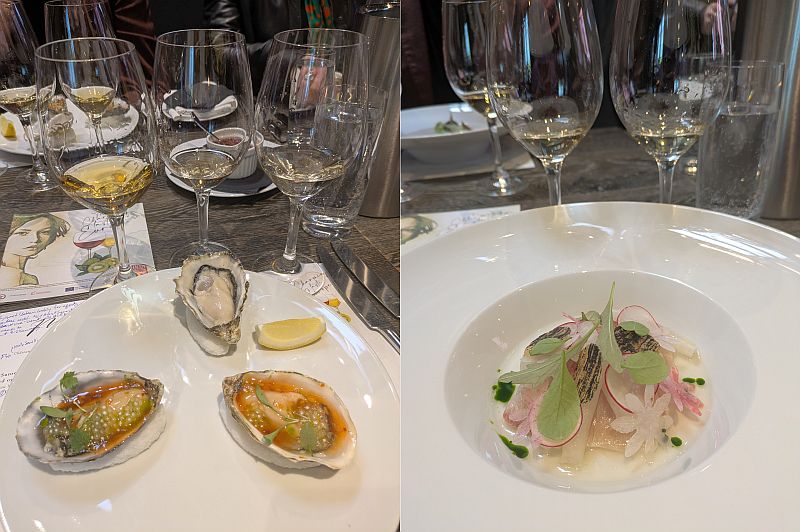
Emma noted that as the industry faces a younger demographic that consumes less alcohol and seeks unconventional pairings, producers are experimenting with diverse vinification styles, such as the use of concrete tanks over oak, and exploring new culinary applications ranging from seafood to spicy cuisines. Which is why one of our pairings are oysters on the half shell paired with sweet Bordeaux white wines.
I quite enjoyed the Sunseeker oyster, with mignonette, lemon along with the two oysters with Thai sweet chili, kaffir lime leaf. BC Sunseeker oysters are one of my favourites. They are plump and creamy. The Château Majoureau 2024, Côtes de Bordeaux Saint Macaire went nicely with the oyster served with mignonette and lemon. The pine needle flavour was subdued a little, which allowed fuller enjoyment of the oyster. The Château Ballan Larquette 2020, Bordeaux paired sweet wine with lightly spicey oyster. The sweetness in the wine cancelled out the saltiness in the oyster. A nice pairing. The Château du Cros 2022, Loupiac was a little too sweet, overpowering the oyster’s flavours in my opinion.
Next the Hamachi crudo, with radish, squid ink crisp, and yuzu vinaigrette, was delicious on its own. I liked the soft texture of the hamachi amberjack fish with the mix of sweetness and sourness from the yuzu viniagrette, plus the crunch from the radish slices. The Château Lagrange – l’Enclos 2024, Bordeaux was a little too dry for the pairing, not bringing out any component in the dish, but the Château Bel Air – Night Owl 2023, Premières Côtes de Bordeaux with its greater degree of sweetness made a terrific complementary pairing. Sweet sometimes is better. I actually found that I usually enjoyed the sweeter wine with all the dishes served.
Sunseeker oysters and Hamachi crudo
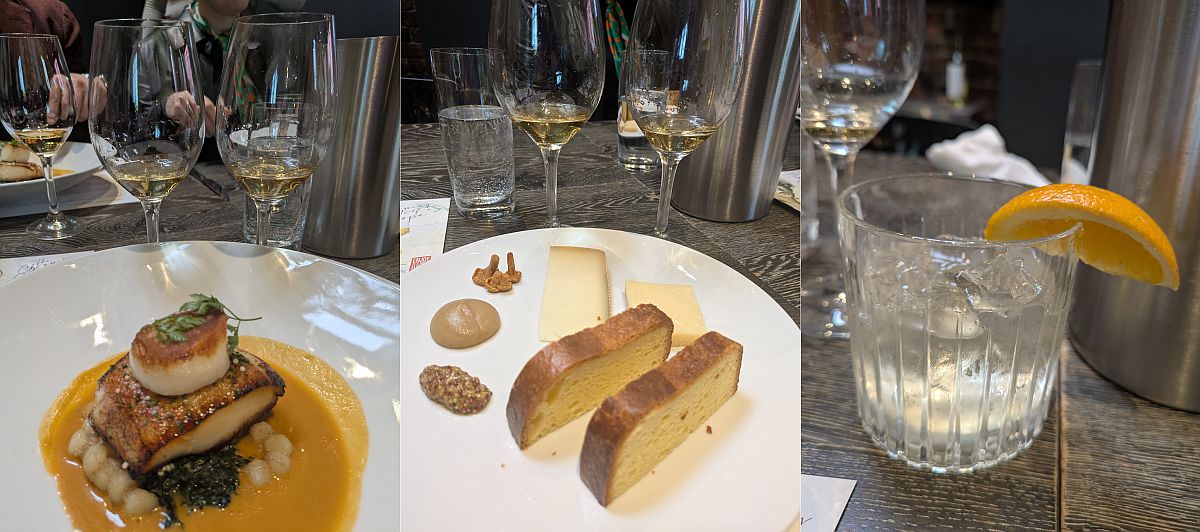
The roasted sablefish with Hokkaido scallop, sautéed spinach, potatoes, and lobster bisque was yet another delicious dish. The soft texture of the scallop, the crisp roasted note and fattiness of the sable fish and the saltiness in the dish were terrific. The Château Perayne 2022, Côtes de Bordeaux Saint Macaire and the Château Fayau 2014, Cadillac were both complementary pairings. The sweetness from these wines was just another aspect of the dish to enjoy. I was able to taste the apricot flavour from the Fayau as well. The sweetness for the Fayau faded quicker than from the Perayne.
Just when you were full, it was time for the cheese assortment. I don’t have the names of the two cheeses that were served, but one was dry, firm, with crystals within, while the other was softer and creamier. Both the Domaine de Pineau cuvée séduction 2016, Cérons and the Château du Pavillon 2016, Sainte Croix du Mont paired nicely with the harder cheese, while the softer cheese went better with the Château du Pavillon.
We were last served a cocktail digestif made with Domaine des Rochers 2018, Loupiac, orange wedge, and sparkling water. No food pairing. It was just meant to cleanse our palate after our filling lunch. The cocktail was refreshing, with light body and had the scent of orange.
The roasted sablefish with Hokkaido scallop, cheese assortment, and cocktail digestif
Thank you to the Vins de Bordeaux for inviting me to this seminar as well as to L’Abbatoir for their delicious food pairings.
Winery Contacts
In case you are an agent that is interested in representing a winery, I have listed the wines and email addresses or websites for the wineries below.
Drink Good Wine. That is my motto and I really want to help you drink good wine. What is good wine? That can be a different thing for each people. Food also loves wine so I also cover food and wine pairings, restaurant reviews, and world travel. Enjoy life with me.
MyWinePal was started by Karl Kliparchuk, WSET. I spent many years with the South World Wine Society as the President and then cellar master. I love to travel around the world, visiting wine regions and sharing my passion for food & wine with you. Come live vicariously through me, and enjoy all my recommended wines.
Try Gerard Bertrand Cote des Roses
Buy Joseph Drouhin Bourgogne Pinot Noir
Video Guide Uncorks the Story of British Columbia Wines. Buy Now.
Donate to the BC Hospitality Foundation
Drink Good Wine
We all want to drink good wine, but sometimes we need help picking a wine. Within this website you will find free information to help you purchase wines from around the world with confidence.
If you have any comments or suggestions on how to improve MyWinePal, please let us know. We value your feedback. Cheers.
Subscribe to MyWinePal's RSS feed:
Follow MyWinePal on Facebook:
Follow MyWinePal on Instagram:
Follow MyWinePal on threads:
Follow MyWinePal on bluesky:
MyWinePal Media Kit:
Buy CVNE Vina Real Crianza from Rioja
Enjoy Luigi Bosca La Linda Old Vines Malbec
Buy Alvear Amontillado sherry
Click to Subscribe to MyWinePal
Subscribe to MyWinePal. Click on image.
Search in MyWinePal
MyWinePal Archive
World-Wide Wine News
(c) MyWinePal. Some articles may contain affiliate linkages.


 –
–