You may have noticed that I have been reviewing and writing about southern Ontario Chardonnay wines, from the Niagara Peninsula in particular. I have undertaken my “Ontario Chardonnay Review” where I review a selection of wines from across southern Ontario, then using the tasting notes and soil maps of the region, to investigate how Chardonnay in the region expresses itself based on soil. Of course there is also temperature and precipitation that also influence terroir, but soil is where the roots live and extract nutrients which then expresses itself in the grapes.
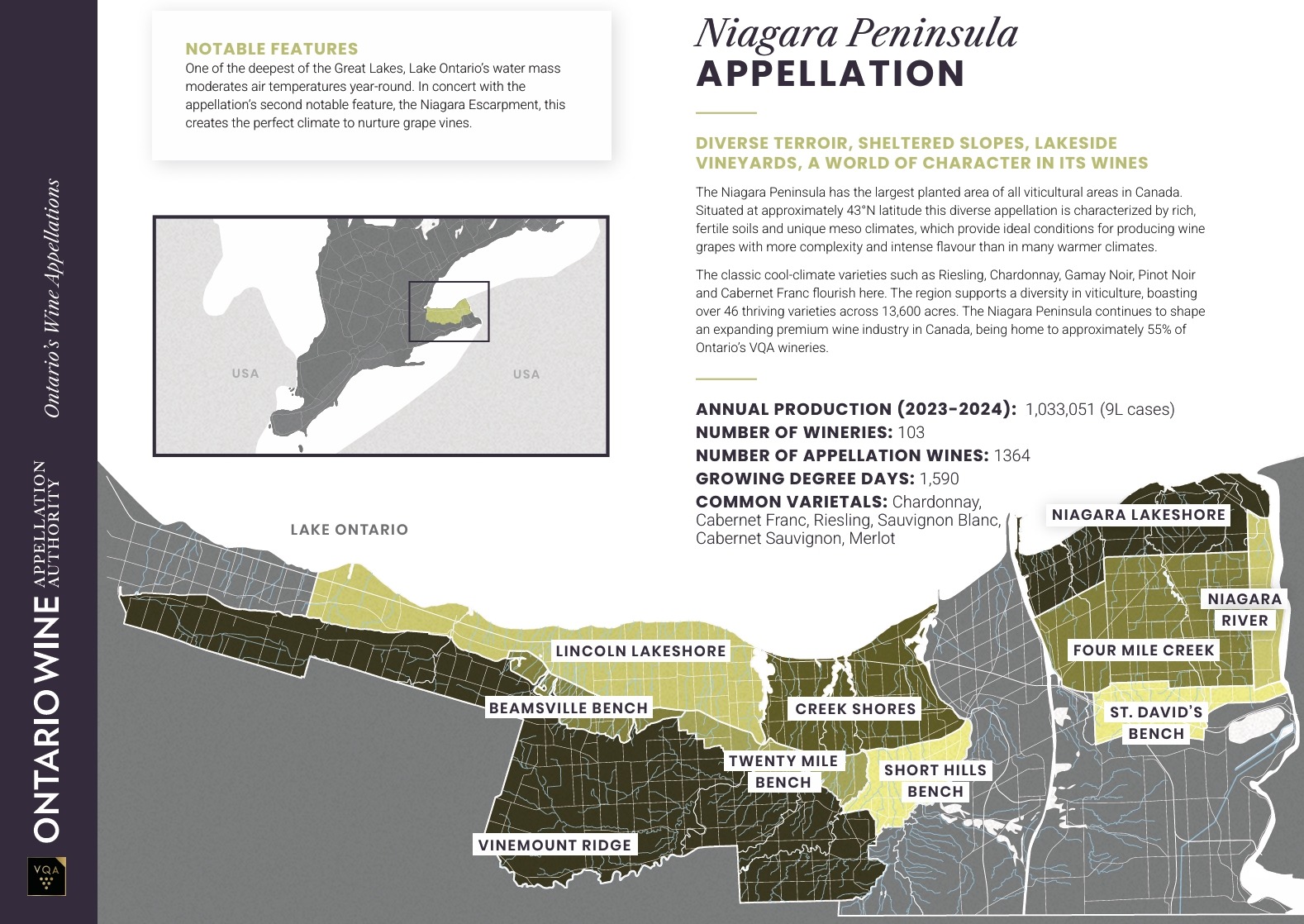
There are sub-appellations in the Niagara Peninsula, where soil type is a major discriminating factor, just like we have in the Okanagan. As I mention the sub-appellations in these articles, I realize that many readers would not know where they are located, so this article covers the sub-appellations of southern Ontario and a map of these sub-appellations.
The Niagara Peninsula
The Niagara Peninsula appellation encompasses 10 sub-appellations:
- Lincoln Lakeshore, Vinemount Ridge, Creek Shores
- Beamsville Bench, Twenty Mile Bench, Short Hills Bench (when grouped together form a regional appellation called the Niagara Escarpment)
- Niagara Lakeshore, Four Mile Creek, St. David’s Bench, Niagara River (when grouped together form a regional appellation called Niagara-on-the-Lake)
(VQA Wines & Appellations – Wine Country Ontario)
These ten distinct sub-appellations, are grouped into three regional areas:
- Niagara-on-the-Lake,
- the Niagara Escarpment, and
- West Niagara.
Niagara-on-the-Lake Region
Niagara River
A narrow strip of land running along the Niagara River, this sub-appellation is defined by its east-facing slopes and the convection currents created by the river’s flow, which moderates temperatures and draws cold air away from vineyards down into the river gorge, warding off frost and supporting an extended growing season. Soils are primarily stratified fine sands, providing natural drainage and encouraging deep root penetration.
Niagara Lakeshore
Sitting on a relatively flat plain with a very gentle slope toward Lake Ontario, this sub-appellation enjoys uninterrupted sunlight throughout the growing season. Its soils consist primarily of glacial and lake-deposited clay and silt over a thick layer of Halton Till, with reddish-brown sandy soils near the lakeshore that promote deep root penetration and excellent drainage, while clay loam soils in the centre retain heat well into early fall.
Four Mile Creek
The largest sub-appellation in the Niagara Peninsula, Four Mile Creek features gentle, almost flat slopes ranging from 89 to 105 metres in elevation. Its sun-soaked soils generate strong convection currents that draw cool air in from Lake Ontario, producing warm days and cool nights with an average diurnal range of over 12°C in September and October, ideal for developing deep colours, flavours, and aromas.
St. David’s Bench
Situated at the foot of the Niagara Escarpment, St. David’s Bench is characterized by deep, rich silty clay and clay loam soils spread over a red sandstone bedrock. These soils hold moisture slowly and steadily, storing spring snowmelt to nourish vines throughout the season. Shelter from the Escarpment provides good cold air drainage and early spring warming, along with a relatively long growing season with frequent clear, sunny conditions.
Niagara Escarpment Region
Short Hills Bench
The most easterly of the Escarpment sub-appellations, Short Hills Bench sits between Twelve Mile Creek and Fifteen Mile Creek. Its gently rolling, flat-topped hills are dissected by numerous north-flowing streams originating from the Escarpment base, creating slopes in multiple directions and providing excellent water drainage. Vineyards away from the Escarpment receive unobstructed sunlight throughout the year.
Twenty Mile Bench
Bisected by Twenty Mile Creek, this sub-appellation has a complex, double-bench topography featuring steep V-shaped valleys, well-developed terraces, and north-facing slopes that provide excellent air drainage. Deep glacial clay and till soils with a high proportion of limestone and shale are moderately well-drained, and their water-holding capacity proves a distinct advantage during the warmer months of the growing season.
Beamsville Bench
One of the most celebrated of the Niagara sub-appellations, Beamsville Bench is a narrow plateau backed by steep Escarpment cliff faces. Its soils are a heterogeneous mix of boulders, gravel, sand, silt, and clay derived from ongoing Escarpment erosion, with dolomitic limestone thought to directly contribute to the pronounced minerality found in wines from this area. The combination of high elevation, short slopes, and lake breeze circulation moderates both day and night temperatures for an extended and even ripening season.
West Niagara Region
Lincoln Lakeshore
Stretching across the Lake Iroquois Plain, Lincoln Lakeshore slopes gently northward to Lake Ontario with no topographic barriers, ensuring uninterrupted sunshine all day. Large streams including Thirty, Forty, and Fifty Mile Creeks cut deep channels through the area, providing excellent seasonal drainage and a reliable water source. Its soils display great variability over short distances, a legacy of its complex glacial and lake-sediment history overlying the red Queenston shale.
Creek Shores
Defined by complex glacial soils of the Lake Iroquois Plains and abundant unobstructed sunlight, Creek Shores benefits from the moderating influence of not only Lake Ontario but also smaller deep-water bodies such as Martindale Pond, Sixteen Mile Pond, and Jordan Harbour, which store summer heat and release it to moderate fall temperatures across the appellation. The result is a warmer, fuller growing environment that yields concentrated, full-bodied wines.
Vinemount Ridge
The highest of the Niagara sub-appellations, Vinemount Ridge sits just above the brow of the Escarpment and encompasses two prominent glacial features: the Fonthill Kame and the Vinemount Moraine, a narrow ridge deposited some 13,000 years ago that reaches 213 metres in elevation. Soils are a rich clay loam till with high water-holding capacity, while the Moraine’s natural drainage prevents waterlogging. Because of its distance from Lake Ontario and exposure to prevailing south westerly winds, the area experiences lower night time temperatures and a higher diurnal range than other sub-appellations, resulting in a shorter but intense growing season.
Soils Map
As soil is one of the defining factors in a region’s terroir, I have a soils map for you. While you may not be a soil scientist who understands the different soil types, it is useful to see the locations of different soils, as discussed in the above sections.
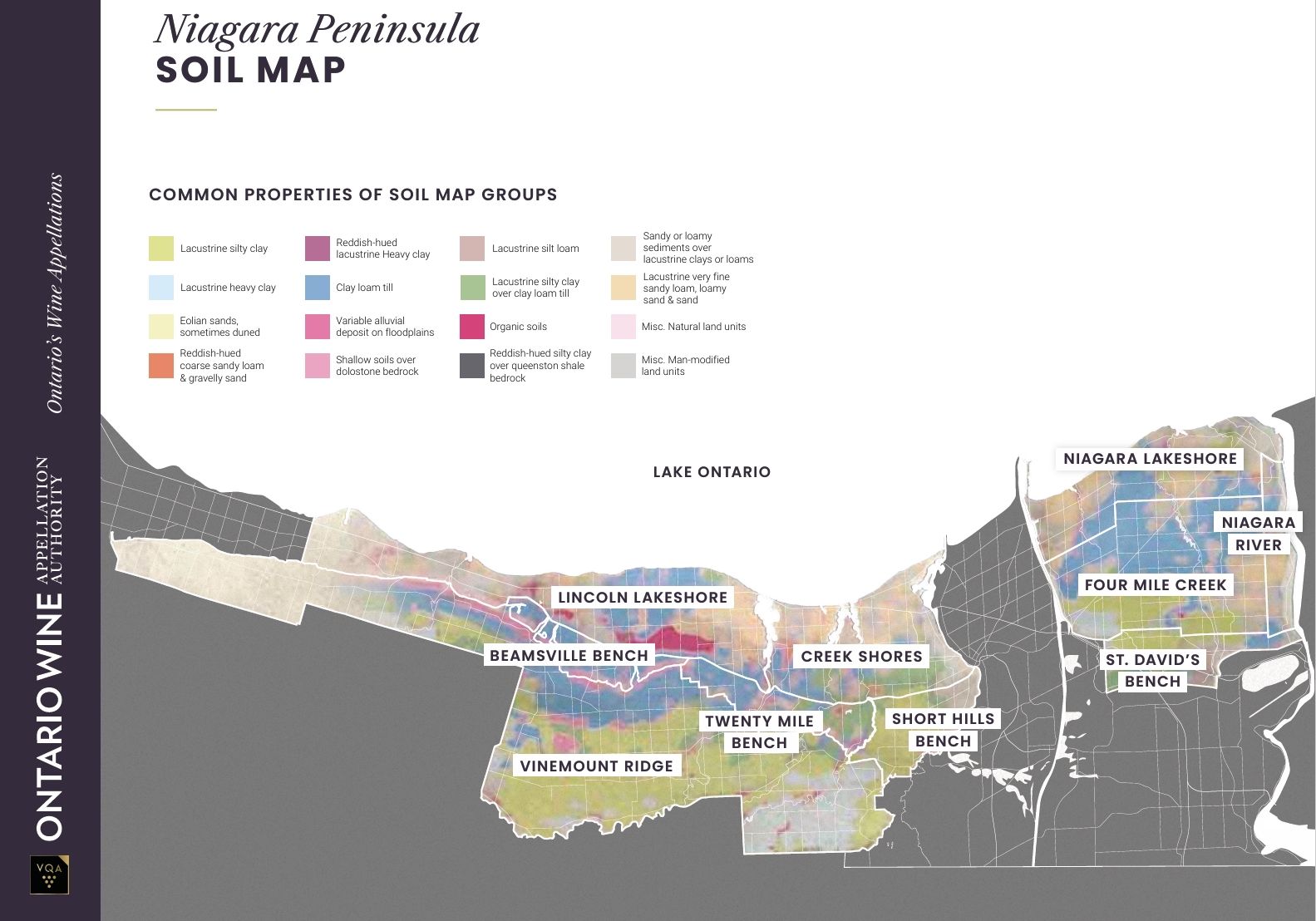
I hope all this information helps you be more informed about the Niagara region for growing grapes and making wine.