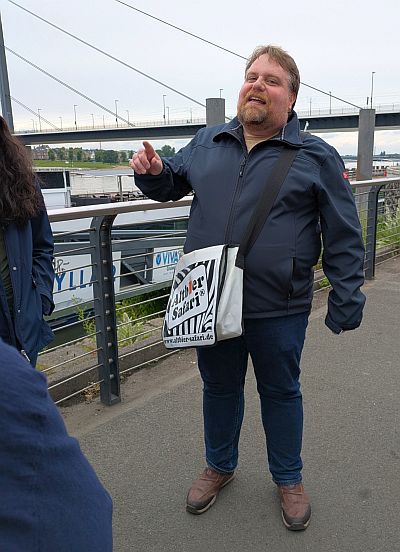
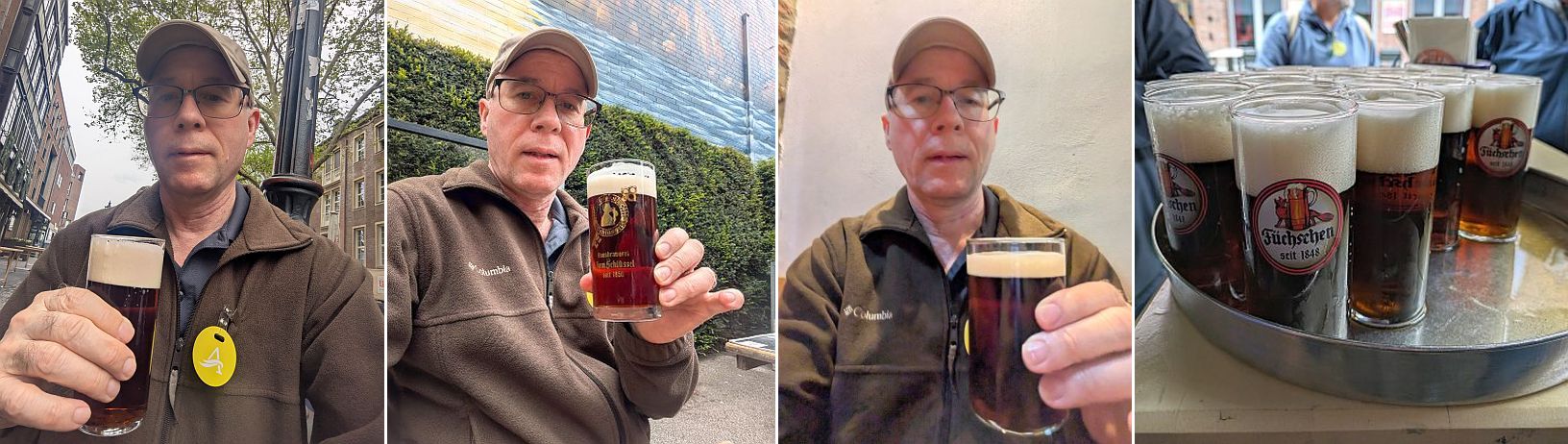
As you may have noticed, I was on a Rhine River Cruise starting in Amsterdam, ending in Basel, Switzerland. But inbetween, I spent many days in German cities. In one city, Düsseldorf, I signed up for a German Altbier walking tour. Here is what I learned about this style of beer from a local guide as he brought us to a few different breweries and provided us samples of their Altbier as he described the process and some details about each brewery.
Literally translated as “old beer,” Altbier refers to the traditional method of brewing that predates the industrial refrigeration required for modern lagers. Technically, it is classified as a top-fermenting ale. However, unlike British ales that often favour a flatter, less carbonated version, Altbier is served with a focus on freshness and high carbonation, a byproduct of fermentation that German brewers meticulously preserve. To truly appreciate this special beer, one must look beyond the glass and understand the rigorous standards that govern its creation. You may notice the frothy head on all the altbiers I sampled during this tour.
The German Purity Law
The foundation of every authentic Altbier is the Reinheitsgebot, or the Purity Law. This framework has maintained the reputation of German brewing for centuries by dictating the use of only four essential ingredients: water, hops, malt, and yeast. Hops serve as the beer’s primary preservative and antibacterial agent. The concentration of hops is measured in IBU (International Bitterness Units); the higher the IBU, the finer and more resistant the foam. From a biological perspective, brewers specifically utilize the female hop plant, which can grow to a staggering six meters due to high levels of the hormone estrogen. This hormonal presence contributes to what locals call the “iconic central European body shape,” aka the beer belly, which one might playfully describe as a protective layer for one’s inner child. While many people enjoy the bitterness of IPA beers, the Altbier is quite subdued in bitterness.
The defining technical characteristic of Altbier is its use of top-fermenting yeast families that work at room temperature. A fascinating technical nuance is that Altbier yeast ignores a specific type of sugar molecule during fermentation, leaving a subtle, residual sweetness. Because this yeast is a living, airborne organism that can drift toward mushy states, breweries must replenish their strains every six months, sourcing fresh cultures from specialized laboratories in Southern Germany, Eastern Germany, or Belgium. So what? As top-fermenting ales are more biologically active at room temperature, they have a shorter shelf life, roughly six weeks, compared to the three months afforded to bottom-fermented Pilsners. This technical limitation dictates a culture of local, immediate consumption. Altbier yields a more complex, “fruity” profile and a richness that industrial lagers cannot replicate, but it must be enjoyed near the source.
The Service and Social Customs
Drinking Altbier in Düsseldorf’s Altstadt (Old Town) is a ritualized experience characterized by a high-trust, no-nonsense environment. The atmosphere is famously described as a “customer service desert,” but in these breweries, rudeness is an invitation to banter. It is a culture that values authenticity and sharp wit over artificial friendliness. The central figure in this environment is the Köbes. These blue-collar servers (sorry I didn’t take a picture) trace their origins to the “fifth sons” of farmers, younger brothers who did not inherit the land and took to the road as wanderers. To gain trust, they often posed as “fake pilgrims” (the name Köbes is a derivative of Jakob, for the Way of St. James). Today, the Köbes is a service specialist who marks a guest’s consumption with pencil strokes on a cardboard coaster. Once you finish your last glass of beer, you place the coaster on top of the glass. The Köbes tallies the marks and charges you for the number of beers you enjoyed.
The rituals of consumption are highly specific. For example, Altbier is served in 0.2-liter glasses (Stangen) to ensure it is finished before it goes stale. Eye contact is mandatory during a toast to prove one is not “poisoning” the other, as the beer is meant to swap slightly between glasses during the bump. Two people toasting each other will clink the bottom edge of the glasses with each other. This part of the beer glass is the thickest and thus less likely to break from toasting.
A Few Altstadt Brewery Profiles
Düsseldorf’s Altstadt is known as the “Longest Bar in the World,” where historical breweries are interconnected, representing different eras of the city’s narrative. (It is the street with the breweries lining it, rather than an actual single bar.)
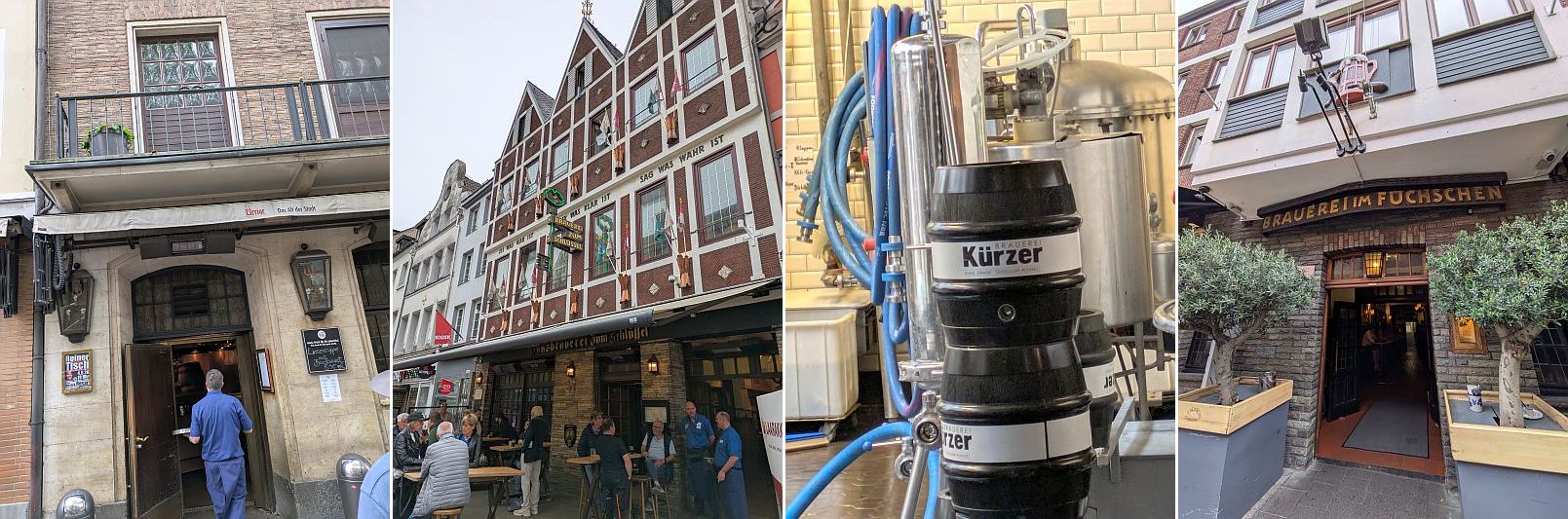
Brauerei zum Uerige (The Brewery of the Unfriendly Old Man): This establishment dates back to 1862, but the building was originally a wine bar called “The Barrel of Hidlebear.” When it transitioned to beer, the owner famously insulted patrons who continued to order wine out of habit. This “unfriendly” brand stuck, and today Uerige produces the most bitter ale in Germany, boasting a sharp 42 IBU.
Zum Schlüssel (The Key): Located in a 500-year-old building, this brewery was historically the residence of the city gate’s key-keeper. To save money on a warden, the key was kept at the bar and handed over to the city’s baker at 3:00 AM as he began his work. The brewery operates under the motto: “Eat food well cooked, drink what is clear, and tell the truth.” Its Altbier is notably sweeter and fruitier than its neighbours.
Brauerei Kürzer: Established in 2010, Kürzer represents the modern microbrewery era. It has captured a younger demographic by offering the maltiest profile in the city, successfully navigating the transition from a grassroots startup to a local staple.
Brauerei im Füchschen (The Small Fox): A final stop on our tour, this brewery’s name means “Small Fox.” It is here that one might hear the joke of the “Schatz-re-chen”, a play on the words for “treasure” (Schatz) and a “small problem” (re-chen). It signifies the end of a physical journey through the breweries, where the only “small problem” left is having to eventually stop drinking. Overall this beer was my favourite as it fell in the middle of the spectrum of aromas and flavours of the beers we tasted. I also liked the beer from Brauerei zum Uerige, which was a bit hoppier than the other beers.
If you get a chance to visit Düsseldorf, make sure to try some fresh Altbier. Prost!